
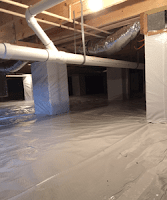
Winter is approaching in Virginia, and without proper home improvement upgrades, many houses will remain just as drafty and uncomfortable as last year. One of the smartest ways to boost comfort and save money is to insulate your crawl space. In Virginia’s mixed climate of hot, muggy summers and chilly winters, traditional vented crawl spaces often lead to damp air, mold and mildew, cold floors, and high energy bills.
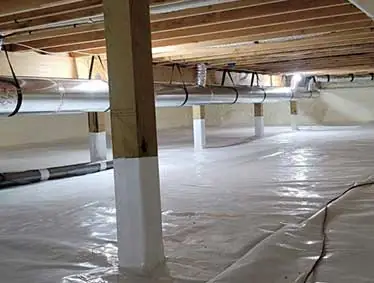 Modern building science recognizes that what’s beneath your home directly impacts how comfortable it feels inside. Thanks to stack effect, air naturally moves upward through your home, from the crawl space, through the living space, and out the attic. That means not only unwanted air, but moisture and pollutants can move up into your home too.
Having a properly sealed, moisture-protected, and insulated crawl space provides long-term benefits. These benefits include greater comfort, energy savings, and indoor air quality. As well as improved home durability and less moisture and pollutants.
Virginia’s Energy Conservation Code allows unvented, encapsulated crawl spaces as an alternative to traditional vented crawl spaces. These unvented areas are required to have insulated walls and a sealed vapor barrier covering the ground.
Let’s explore some of the benefits of sealing and insulating the crawl space of your Virginia home.
1. Improved Indoor Air Quality
When you install insulation and air seal your crawl space, you’re not just improving comfort, you’re protecting the air you breathe. Traditional vented crawl spaces were designed to “let moisture out,” but in our state’s humid climate, they often let more moisture in. Over time, this can create a damp, musty space that attracts pests and spreads odors and allergens upward through your home.
Due to the stack effect, roughly 40% of your home’s air can rise from the crawl space below. That means damp, moldy air, and everything in it, flows into your living space, contributing to asthma and allergy issues. Thick vapor barriers, sealed vents, and air sealing and insulating stop this cycle. They block moisture from soil and humid outside air, soil gases like radon, and other pollutants that can seep up from the ground. You’ll even notice that musty odors disappear.
A well-sealed crawl space also discourages pests. Damp wood attracts termites and carpenter ants, while moldy debris provides a comfy home for rodents and dust mites. Keeping your crawl space dry and temperate makes it much less appealing to unwanted guests. Professional installers, like the team from Southland Insulators, follow Virginia building code by leaving a termite inspection gap along the top of your foundation wall so that pest inspections remain easy and effective.
2. Lower Energy Bills
Uninsulated or open crawl spaces are notorious for wasting energy. During winter, cold air circulates under your floors, causing your HVAC system to run overtime. In summer, that same space pulls in humid outdoor air, forcing your air conditioner to work harder and battle extra humidity. This means higher energy bills and unnecessary wear on your heating and cooling system.
 Encapsulating your crawl space by closing vents, adding a vapor barrier, and insulating the walls, helps bring the area within your home’s conditioned envelope. Even better, the U.S. Department of Energy reports that having an unvented, conditioned crawl space can cut your heating and cooling energy use by 15–18%. Your energy savings will continue to accrue monthly, especially during our temperature extremes.
If your HVAC system or ductwork runs through the crawl space, you stand to gain even more. In a vented, uninsulated crawl space, your ducts are exposed to extreme temperatures often causing air leaks. These leaky ducts pull in unconditioned outside air into your HVAC system, raising your cooling costs by as much as 20-30%.
By properly insulating and sealing your crawl space walls, you:
- Keep the area closer to your home’s interior temperature.
- Prevent duct leaks from sucking in outside air.
- Contain leaked conditioned air within a sealed space.
- Deliver heated/cooled air more effectively to your upper rooms.
- Reduce HVAC cycling and wear and tear.
Adding insulation between your floor joists or along your crawl space walls helps eliminate cold drafts and keeps your floors warmer. Whether you choose rigid foam or spray foam insulation, each type helps keep your home energy efficient and easier to maintain comfortable temperatures year-round.
3. A More Comfortable Home
If your floors feel icy on a winter the morning or your first floor is much cooler than your upstairs, your crawl space could be the reason. Unfinished, vented crawl spaces often cause uneven temperatures and drafts. Once you seal and insulate the space, indoor conditions become noticeably more stable.
An insulated and encapsulated crawl space with closed-cell spray foam or rigid foam insulation stays warmer in winter and cooler in summer. You’ll notice fewer drafts, less humidity, and more consistent comfort from floor to floor. During our humid Virginia summers, an encapsulated crawl space helps your air conditioner run more efficiently and your indoor air feel less clammy. And when paired with a dehumidifier or small HVAC supply, it helps keep even more moisture out.
Beyond comfort, these improvements also protect your home’s structure. A sealed crawl space helps prevent wood rot, protects your subflooring, and reduces the expansion and contraction that cause creaky floors and drywall cracks. With added insulation, you’ll even hear less noise from your plumbing and HVAC equipment.
Creating Energy-Efficient Homes for Our Virginia Community
 Sealing and properly insulating your crawl space is one of the smartest home improvement projects you can do. It boosts air quality, reduces energy loss, helps prevent mold and mildew, and makes your living space far more cGas Fireplace Installation — Before | Perfection Supplyomfortable year-round.
At Southland Insulators, we specialize in sealing and insulating crawl spaces across Northern Virginia. No matter what your insulation needs are, from spray foam insulation, fiberglass batts, or expert help to install insulation, our experienced team delivers professional results you can trust. We’ve been Virginia’s go-to insulation experts since 1986, helping thousands of homeowners make their homes more energy efficient and comfortable.
Don’t wait for another chilly winter. Improve your Virginia home’s comfort and save money on your energy bills by insulating your crawl space. Contact us today to schedule your free crawl space evaluation and estimate.
____________________________________________________________________________________
References
Building Science Corporation. (n.d.). Crawlspace insulation. Building Science. https://buildingscience.com/documents/information-sheets/crawlspace-insulation
Hales, D. (2010). Unvented conditioned crawlspaces: Research on field performance in various climates. Oak Ridge National Laboratory. https://web.ornl.gov/sci/buildings/conf-archive/2010%20B11%20papers/174_Hales.pdf
ICC Digital Codes. (n.d.) R402.2.10.1 Crawl space wall insulation installations. 2021 Virginia Energy Conservation Code. https://codes.iccsafe.org/content/VAECC2021P1/chapter-4-re-residential-energy-efficiency#VAECC2021P1_RE_Ch04_SecR402.2.10.1
James City County. (n.d.). Crawl space encapsulation plan review and inspection requirements. James City County, Virginia. https://www.jamescitycountyva.gov/DocumentCenter/View/13058/Crawl-Space-Encapsulation-Plan-Review-and-Inspection-Requirements-PDF
Morrison, D. (2010). Understanding the stack effect. Green Building Advisor. https://www.greenbuildingadvisor.com/article/understanding-the-stack-effect
U.S. Department of Energy. (n.d.). Unvented, conditioned crawlspaces: building america top innovation profile. Office of Energy Efficiency & Renewable Energy. https://www.energy.gov/eere/buildings/articles/unvented-conditioned-crawlspaces-building-america-top-innovation
U.S. Environmental Protection Agency. (n.d.). Technology fact sheet: Crawlspace insulation. ENERGY STAR. https://www.energystar.gov/sites/default/files/asset/document/Technology%20Fact%20Sheet%20Crawlspace%20Insulation.pdf
Virginia Department of Health. (May 2024). EPA radon risk map for Virginia. Radiological Health. https://www.vdh.virginia.gov/radiological-health/indoor-radon-program/epa-radon-risk-map-for-virginia/
Weather Spark. (n.d.). Climate and average weather year-round in Manassas. Weather Spark.com. https://weatherspark.com/y/20966/Average-Weather-in-Manassas-Virginia-United-States-Year-Round#Sections-Humidity