
Modern homes are built to be efficient. In Virginia, that means tighter construction, fewer air leaks, and better insulation. Most Virginia homeowners assume their home ventilates itself the way older homes did, through natural air leaks. However, Virginia’s 2021 Residential Code requires a level of envelope tightness that essentially eliminates that uncontrolled air exchange, leaving newer and recently retrofitted homes without enough fresh air unless a mechanical ventilation system is installed.
That creates a buildup of moisture, allergens, and pollutants inside the home. To make matters worse, the U.S. EPA reports that Americans spend roughly 90% of their time indoors, and that inadequate ventilation can let pollutants accumulate to levels associated with eye, nose, and throat irritation, headaches, fatigue, and worsened asthma and allergies.
Here’s the shift: modern construction has made mechanical ventilation Virginia homes depend on non-negotiable. Older Virginia homes leaked enough air to ventilate themselves by accident. Modern Virginia homes — built to the 2021 Virginia Residential Code or retrofitted with significant air sealing — do not. The 2021 VRC now requires whole-house mechanical ventilation in new homes, sized in line with ASHRAE Standard 62.2. The four common system types are exhaust-only, supply-only, balanced, and balanced with a heat or energy recovery ventilator (HRV/ERV). Balanced systems with energy recovery are typically the strongest fit for Virginia’s mixed-humid Climate Zone 4A.
Wondering whether your home is sealed tightly enough to need mechanical ventilation? A home performance evaluation can identify air leaks, ventilation gaps, and whether air sealing is part of the solution.
Why Modern Virginia Homes Can’t Ventilate Themselves
From Leaky to Tight: A Two-Decade Shift
Older homes were unintentionally ventilated. Air moved in and out through cracks around windows, attic penetrations, ductwork, and framing joints. It wasn’t efficient, but it did provide airflow. Building products of that era also contained fewer additives, so indoor pollutant loads were lower.
Today’s homes are different. Construction practices have shifted toward tighter building envelopes to improve energy efficiency. That means fewer uncontrolled air leaks—and less natural airflow. When natural ventilation drops and no mechanical system replaces it, indoor air quality suffers.
This matters because indoor air isn’t static. Moisture from cooking and showers, VOCs from materials and cleaning products, and allergens all accumulate inside the home if they’re not actively removed. The U.S. EPA estimates Americans spend roughly 90% of their time indoors, which makes indoor air quality a meaningful health factor, not a niche one.
What “Tight” Means in Virginia Today
Virginia adopted the 2021 Uniform Statewide Building Code, which incorporates updated energy efficiency standards. Under this code, new homes must include mechanical ventilation systems that meet minimum airflow requirements.
In practical terms, that means:
- Homes are now sealed tighter than ever
- Natural air leakage is no longer enough for ventilation
- Whole-house ventilation systems are required, not optional
This is also why air sealing and ventilation go hand in hand. Sealing a home without adding ventilation traps pollutants inside. Adding ventilation without sealing wastes energy and reduces system effectiveness.
What the 2021 Virginia Code Requires
Whole-House Mechanical Ventilation Is Now Required
Under the current code, new homes must include whole-house ventilation systems designed to meet airflow targets aligned with ASHRAE 62.2. ASHRAE 62.2 is the residential ventilation standard that the EPA references for setting target air exchange rates inside homes. The EPA cites a baseline of approximately 0.35 air changes per hour, but no less than 15 cfm per person.
This standard defines the amount of fresh air a home needs based on its size and occupancy. It ensures a consistent level of air exchange to maintain acceptable indoor air quality.
Local exhaust systems, like bathroom and kitchen fans, are still required. But they’re no longer enough on their own. Whole-house systems provide continuous, controlled airflow throughout the home.
Why Climate Zone 4A Matters
Most of Virginia, including Northern Virginia and the Shenandoah Valley, falls into IECC Climate Zone 4A, which is classified as mixed-humid.
That combination matters because:
- Winters are cold enough to benefit from heat recovery
- Summers are humid enough to create moisture problems
Because of this, system choice isn’t just about airflow, it’s about how that airflow interacts with temperature and humidity.
The Four Whole-House Ventilation Systems
There are four main types of whole-house ventilation systems, and each works differently.
Exhaust Ventilation System
An exhaust ventilation system removes indoor air using a fan, typically through bathrooms or a central exhaust point. Replacement air enters through leaks and passive openings.
Pros:
- Lower cost
- Simple installation
Cons:
- Can draw pollutants into the living space
- May cause backdrafting in homes with combustion appliances
- Not appropriate for hot humid climates
- Generally a weaker choice for Virginia summers, when depressurization can pull humid outdoor air into wall cavities
Supply Ventilation System
A supply ventilation system brings filtered outdoor air into the home using a fan. Indoor air exits through natural leaks. This results in the system pressurizing the home, which helps prevent backdrafting and lets the homeowner filter and dehumidify incoming air.
Pros:
- Allows filtration of incoming air
- Helps prevent backdrafting from combustion appliances
Cons:
- Does not actively manage humidity without added equipment
- Still relies on uncontrolled leakage for exhaust
Balanced Ventilation
Balanced ventilation uses two fans: one to bring fresh air in and one to exhaust stale air out, at roughly equal rates.
Pros:
- Controlled airflow in both directions
- Works in all climates, as classified by the DOE
Cons:
- Higher installation cost than exhaust- or supply-only
- Does not recover energy or manage moisture
HRV vs ERV (Energy Recovery Systems)
The most advanced option is a balanced system with energy recovery.
An HRV (heat recovery ventilator) transfers heat between incoming and outgoing air. An energy recovery ventilator (ERV) transfers both heat and moisture. The DOE Building America Solution Center (Pacific Northwest National Laboratory) notes that HRVs and ERVs help dilute moisture, dust, pollen, and particulates that can trigger asthma and allergy attacks.
Pros:
- Maintains indoor temperature more efficiently
- Helps manage humidity
- Improves overall indoor air quality Virginia homes depend on
- Cost-effective in climates with extreme winters or summers and high fuel costs
Cons:
- Higher upfront cost
- Requires regular maintenance
In IECC Climate Zone 4A, ERVs are typically the best fit because they address both temperature and humidity, two of Virginia’s biggest challenges.
Choosing the Right System for Your Virginia Home
Three Factors That Drive the Decision
1. Envelope tightness
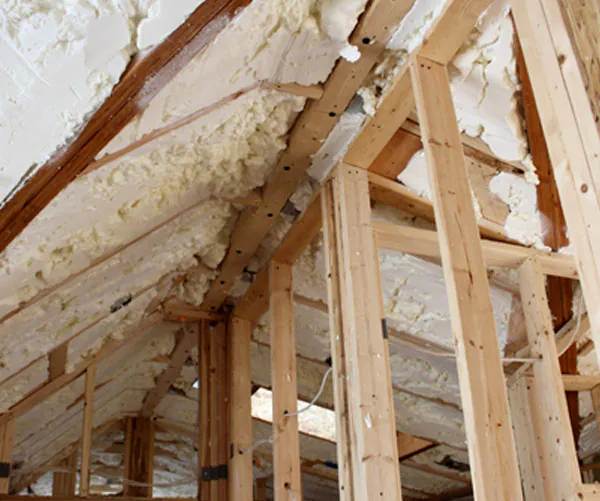
The tighter the home, the more important balanced ventilation or energy recovery becomes. Homes with extensive air sealing or spray foam insulation won’t get enough airflow naturally and need a designed ventilation system from day one.
2. Combustion appliances
Homes with gas appliances or fireplaces are more sensitive to pressure imbalances. Exhaust-only systems can create backdrafting risks, making balanced systems the safer choice.
3. Humidity
Virginia summers regularly run above 70% relative humidity, meaning that an ERV that transfers some incoming moisture back to the exhaust stream helps keep summer humidity manageable. On the other hand, an HRV is better suited to drier, colder climate.
Pair Ventilation With Air Sealing — Always
A ventilation system only works if it controls the airflow. If your home is full of uncontrolled leaks, fresh air will enter wherever it can, not where it should. That makes the system less effective and less efficient.
That’s why air sealing should come first.
Sealing key areas like the attic floor, rim joists, and duct penetrations creates a controlled environment where ventilation systems can actually do their job.
Upgrading your attic insulation and sealing the attic plane is what turns the building envelope into a true thermal and air boundary. Until that boundary exists, the ventilation system is fighting random leaks in every direction.
For homes with raised floors over vented crawl spaces, sealing and insulating the crawl space is often a higher-impact moisture and air quality upgrade than any single ventilation product.
Ventilation used to be something Virginia homes did by accident. Tighter envelopes and current code now make it a design decision — one with real consequences for indoor air quality, comfort, and energy bills.
Tighter construction has made mechanical ventilation Virginia homeowners rely on essential for maintaining comfort, health, and efficiency. And with Virginia’s mixed-humid climate, system choice matters.
In most cases, balanced ventilation systems with energy recovery—especially an energy recovery ventilator—offer the best performance.
But the real solution isn’t just ventilation. It’s the combination of ventilation and air sealing and ventilation working together as a system.
If you’re not sure what your home needs, a professional evaluation can identify where air is leaking, how your current ventilation performs, and what upgrades will actually make a difference.
References:
National Institute of Environmental Health Sciences. “Indoor Air Quality.” U.S. Department of Health and Human Services, www.niehs.nih.gov/health/topics/agents/indoor-air.
Pacific Northwest National Laboratory. “Balanced HRV/ERV.” Building America Solution Center, U.S. Department of Energy, basc.pnnl.gov/home-improvement-expert/checklists/balanced-hrverv.
U.S. Department of Energy. “Whole-House Ventilation.” Energy Saver, www.energy.gov/energysaver/whole-house-ventilation.
U.S. Environmental Protection Agency. “How Much Ventilation Do I Need in My Home to Improve Indoor Air Quality?” EPA Indoor Air Quality, www.epa.gov/indoor-air-quality-iaq/how-much-ventilation-do-i-need-my-home-improve-indoor-air-quality.
U.S. Environmental Protection Agency. “Improving Indoor Air Quality.” EPA Indoor Air Quality, www.epa.gov/indoor-air-quality-iaq/improving-indoor-air-quality.
U.S. Environmental Protection Agency. “Introduction to Indoor Air Quality.” EPA Indoor Air Quality, www.epa.gov/indoor-air-quality-iaq/introduction-indoor-air-quality.
U.S. Environmental Protection Agency. “The Inside Story: A Guide to Indoor Air Quality.” EPA Indoor Air Quality, www.epa.gov/indoor-air-quality-iaq/inside-story-guide-indoor-air-quality.
Virginia Department of Housing and Community Development. “2021 Virginia Residential Code Significant Changes Frequently Asked Questions.” Commonwealth of Virginia, www.dhcd.virginia.gov/sites/default/files/DocX/technical-memos-bulletins/2021-vrc-faq.pdf.
Virginia Department of Housing and Community Development. “Virginia Uniform Statewide Building Code (USBC).” Commonwealth of Virginia, www.dhcd.virginia.gov/virginia-uniform-statewide-building-code-usbc.
Virginia Tech Environmental Health and Safety. “Indoor Air Quality.” Virginia Polytechnic Institute and State University, ehs.vt.edu/programs/occupational-safety/indoor-air-quality.html.