

Asthma, Allergies, and Indoor Air Quality in Virginia
Asthma is a common chronic condition that more than 28 million Americans live with. Here in Virginia, roughly one in ten adults has been diagnosed with asthma in their lifetime, while about one in fifteen adults is currently dealing with the condition.
Common asthma triggers include pollen, mold spores, dust, pet dander, chemical fumes, tobacco smoke, pest debris, weather changes, and respiratory infections. Our Virginia climate can make these problems worse. Fall brings high ragweed pollen counts, while damp leaves and humidity increase mold growth. In fact, Richmond, Virginia was ranked as the 16th “Asthma Capital” in the U.S. in 2025 and the 8th most challenging city for seasonal allergies.
Most of us spend about 90% of our time indoors. While this might seem like a good refuge from the many outdoor pollutants, research shows that indoor air can be at least two to five times more polluted than outdoor air, and in some cases, much higher. That is a big deal for anyone dealing with respiratory issues, allergies, or asthma.
Keeping these outdoor pollutants out of your home is one of the most effective ways to minimize asthma triggers and support breathing easier indoors. Let’s look at the best ways to keep your indoor air clean and healthy so you can breathe easier.
The Problem with Leaky Homes and Uncontrolled Airflow
Simply closing your windows and doors is not enough to ensure your indoor air stays clean. Many Virginia homes, especially older ones, have hidden gaps that allow outside air to slip in. This is known as air infiltration.
A “leaky” home can pull in humidity, radon, mold spores, pollen, dust, insects, and even pesticides from its attic, crawl space, and the outdoors. During windy or cold weather, too much outside air can enter your home, while during calm, hot weather, not enough fresh air moves through.
The solution is not a drafty house. The best approach for your home is to seal air leaks, then add controlled ventilation. Having a properly sealed and ventilated home ensures better indoor air quality than a leaky one.
Uncontrolled airflow through cracks can change with wind speed, outdoor temperature, and nearby vegetation. Undergoing building envelope sealing puts you back in control of your indoor environment. When you prevent air infiltration, fewer pollutants can enter, and excess moisture and odors can be removed with planned ventilation.
Air Sealing for Asthma Relief – How It Helps
Air sealing closes the holes and cracks in your home’s walls, ceilings, floors, and other parts of your home’s exterior shell. This creates a barrier that helps keep outdoor pollutants outside.
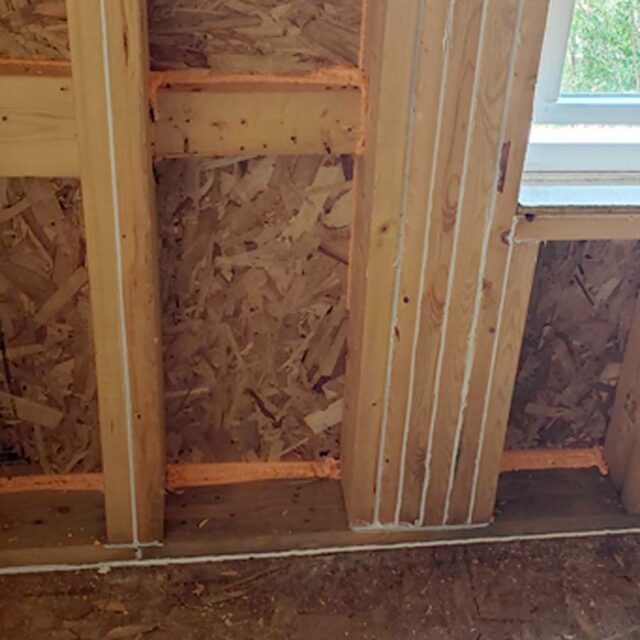 Once leaks are sealed, indoor air is easier to manage since you’re no longer fighting a constant stream of allergens entering your home. Here in Virginia, where our pollen is plentiful and our summer outdoor humidity is high, air sealing becomes even more important.
When warm, humid outside air leaks into your home, it can raise moisture levels and carry mold spores into your home. Mold and other fungi are among the most common allergens and can act as irritants or toxic agents. Since mold cannot grow without moisture, humidity control is key to keeping mold growth at bay. Ideally, your indoor humidity should stay between 40–55%. Sealing leaks helps your AC system reduce indoor humidity without having to also dry off humid outside air.
Air sealing can also help reduce the entry of sewer gases and radon through foundation cracks. With a tighter home, it’s easier to manage indoor particulates using high-quality HVAC filters that together can better reduce dust and allergens, reduce pollen and mold spores, and help asthma sufferers maintain a healthier indoor environment.
Insulation and Air Sealing Solutions (Why Spray Foam Shines)
Common air sealing methods include caulking around windows and baseboards, weatherstripping doors and attic hatches, and using expanding foam to seal gaps and cracks. The Department of Energy (DOE) recommends sealing penetrations with caulk or spray foam where wiring, plumbing, and ductwork pass through walls, attics, and crawl spaces.
Spray foam insulation stands out as a quality choice because it both insulates and air-seals in one step. When applied, it expands to fill irregular openings, cracks, and crevices, creating an airtight barrier. This makes it ideal for sealing around pipe penetrations, sill plates, rim joists, and other irregular openings.
Unlike fiberglass batts or loose-fill insulation, which can leave gaps and may be less effective at stopping airflow, spray foam creates a continuous seal. It helps reduce air leakage, improves comfort, and boosts HVAC efficiency. Closed-cell spray foam also helps to prevent mold growth by providing a moisture barrier. Open-cell spray foam is a lighter option that is equally effective at air sealing but doesn’t include a vapor barrier.
Additional benefits of air sealing with spray foam include a quieter home, improved comfort, energy efficiency benefits, and the ability to reduce energy bills. Professional installation is critical to ensure safety and performance.
Making Your Home Asthma-Friendly
Improving indoor air quality through air sealing is a proactive step toward having a healthier home for asthma sufferers. Home air sealing works best when paired with proper ventilation. After tightening your house, it’s important to ensure you have adequate fresh air exchange. Some of the best ventilation options include exhaust fans with controlled inlets, windows, vents, and mechanical ventilation like Energy Recovery Ventilation (ERV) and Heat Recovery Ventilation (HRV) systems.
The advantage of proper ventilation is control because you decide when and how fresh air enters. Also, remember to complement air sealing with regular HVAC filter changes, moisture control, and cleaning routines that minimize dust to reduce indoor air pollutants further.
You may choose to have a professional perform a home energy audit, including a blower door test, to identify problem areas. Then you can systematically seal air leaks. As the leaks are sealed, your home’s air will smell cleaner, dust will settle less, and you’ll notice fewer allergy symptoms. The goal is a balanced, controlled environment that keeps bad air out and efficiently cycles in good air.
Create a Healthier Home with Southland Insulators
If you want to improve indoor air quality, protect your family’s health, and create a more comfortable living space, professional help matters. Southland Insulators is a trusted insulation and air sealing company in Virginia with decades of experience serving homeowners in Northern Virginia and beyond.
Our team provides professional air sealing services and insulation upgrades, including spray foam installation. Our solutions are designed to reduce dust and allergens, improve comfort, and support your family’s long-term health. You can count on Southland Insulators to do the job right. Contact us today to take the next step towards creating a healthier, more comfortable living space for your family.
References
Asthma and Allergy Foundation of America. (2025). Asthma facts and figures [Fact sheet]. https://aafa.org/wp-content/uploads/2025/04/aafa-asthma-facts-and-figures.pdf.
American Lung Association. (n.d.). Indoor air quality. Retrieved from https://www.lung.org/clean-air/indoor-air.
Gilliland, S. (2025, April 10). Why Hampton Roads is one of the nation’s worst areas for pollen allergies. Virginia Mercury. https://virginiamercury.com/2025/04/10/why-hampton-roads-is-one-of-the-nations-worst-areas-for-pollen-allergies/.
Richmond City Health District. (2025, September 22). RHHD encourages people experiencing asthma symptoms to seek care. Virginia Department of Health. https://www.vdh.virginia.gov/richmond-city/2025/09/22/rhhd-encourages-people-experiencing-asthma-symptoms-to-seek-care/.
U.S. Department of Energy. (n.d.). Air sealing your home. Energy Saver. https://www.energy.gov/energysaver/air-sealing-your-home.
Virginia Cooperative Extension. (n.d.). Healthy indoor air: Ventilation (Publication 2908-9024). Virginia Tech. https://www.pubs.ext.vt.edu/2908/2908-9024/2908-9024.html.
Virginia Cooperative Extension. (n.d.). Indoor air quality (Publication 2901-9008). Virginia Tech. https://www.pubs.ext.vt.edu/2901/2901-9008/2901-9008.html.
Virginia Department of Education & Virginia Department of Health. (2023). Guidelines for asthma management in Virginia schools. https://www.vdh.virginia.gov/content/uploads/sites/58/2023/01/Guidelines-athma-management-VADOE.pdf.
Virginia Department of Health. (2018). The burden of asthma in Virginia. https://www.vdh.virginia.gov/content/uploads/sites/94/2018/11/Asthma-Burden-Report_Final_10232018-1.pdf.